Responsible Living Wage standard: a new benchmark for fair pay certification

The Responsible Living Wage (RLW) standard is a third-party certification that verifies whether employers pay workers a living wage.
Brands and their suppliers are accustomed to navigating a diverse array of social certification schemes, scorecards and improvement plans, including programmes like SMETA, SA8000, Amfori BSCI, CSDDD, CSRD, Fairtrade, GoodWeave, and Better Cotton.
Living wage, in one form or another, sits within most of these frameworks. So why do we need another standard, and what does the Responsible Living Wage standard actually add to a landscape that already, on paper, addresses fair pay?
Why is the Responsible Living Wage standard necessary?
Despite growing attention on responsible sourcing and human rights, the gap between minimum wages and the real cost of living is a persistent challenge across global supply chains.
Meeting local wage laws does not necessarily mean workers can afford a decent standard of living. In many countries, minimum wages are updated infrequently and often fall short of covering basic needs such as housing, food, healthcare, education and transport.
The scale of the issue is significant. According to research by the World Benchmarking Alliance, fewer than 5% of the world’s 2,000 most influential companies guarantee a living wage for their own workforce, while only 3% actively support living wages within their supply chains.[1]
The issue also has an important gender dimension. Women are heavily represented in many lower-paid sectors and carry a disproportionate share of unpaid care responsibilities. According to the World Inequality Report 2026, women receive only around 35% of global labour income despite representing half of the world’s population.[2] Improving wage levels can therefore contribute to greater financial security for workers while helping to address wider economic inequalities.
As expectations from regulators, investors and customers continue to rise, organizations increasingly need a credible way to demonstrate that their approach to fair pay extends beyond legal compliance. The Responsible Living Wage standard provides that assurance.
[1] World Benchmarking Alliance, State of Play: Corporate Performance on Living Wages (2026).
[2] World Inequality Report 2026.
Living wages in key sectors
Textiles/garments: <10% of companies disclose living wage compliance
Agriculture: <5% of plantations meet living wage
Food supply chains: Only 3% of companies act on living wage in supply chains
Gig economy: Most workers earn below the living wage after expenses
Living wage vs minimum wage: why most certifications fall short
Most established social compliance standards reference living wage to some degree. But there’s a big difference between a standard that references living wage and a standard that certifies it.
Other social compliance standards include a living wage gap analysis, comparing worker remuneration against region-specific benchmarks and requiring a wage improvement plan where shortfalls are identified. Some other social compliance standards define living wage by reference to the Anker Methodology and expects organizations to work towards it as part of fair remuneration, or requires certified organizations to meet legal minimum wage requirements while demonstrating progress towards a living wage that covers food, housing, healthcare, education, transport and discretionary income.
On paper, these provisions look substantial. In practice, living wage tends to be only one requirement among many, covering a wide range of areas such as health and safety, working hours, freedom of association, management systems and more. Within that broader scope, living wage is most often addressed through a roadmap or improvement plan rather than as a condition of certification itself.
A business can hold a well-known social standard’s certificate while still paying workers below a living wage, for example, provided it has a credible plan in place to close the gap over time.
This creates a visibility problem. Two facilities, both holding the same certification, can be in very different positions: one may already be paying a living wage, while the other has simply committed to a five-year improvement plan. The certification merely confirms the topic has been considered. It does not confirm the outcome.

What is the Responsible Living Wage standard?
Rather living wage being one element within a broad social compliance system, the RLW standard makes the payment of a living wage the central element of the certification, verified against an objective local benchmark.
RLW is one of the only globally available, third-party certifiable standards focused specifically and exclusively on a living wage. Other organizations publish living wage benchmarks and reference data, but these function as reference points rather than as the basis for an auditable certification. The RLW standard turns that benchmark data into a verifiable compliance outcome.
This focus is reflected in the structure of the standard itself.
The RLW checklist comprises 10 sections and 54 distinct requirements, covering many areas.
RLW Checklist: Key Sections & Requirements
- Living wage commitment and governance
- Living wage benchmarking methodology
- Verification procedures, including payroll data, payslips and contracts
- Responsible purchasing and supply chain management
- Working hours and timekeeping compliance
- Payment cycle requirements
- Corrective and preventive action planning
- Grievance mechanisms
- Training and stakeholder communication
- Legal compliance and awareness
RLW certification levels explained
RLW certification has three possible outcomes: Certified Living Wage Provider, On-Track to be a Living Wage Provider, and On Improvement Pathway.
Like other social compliance schemes, the RLW standard recognises that closing the gap between current wages and a living wage benchmark can take time, particularly across complex, multi-tier supply chains. Rather than a yes/no outcome, the three designations indicate different statuses of RLW performance.
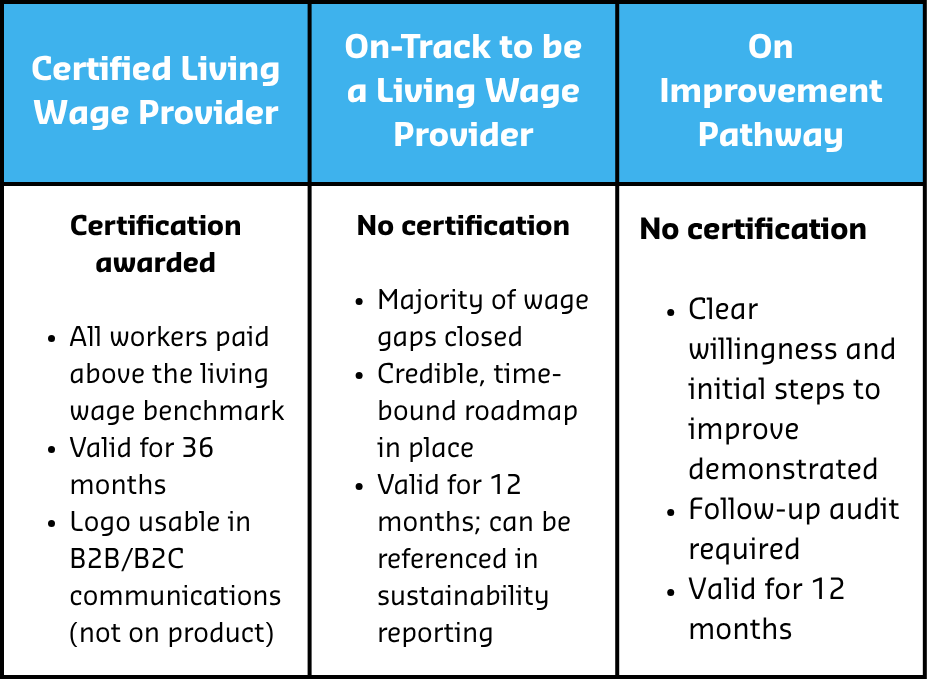
Where certification is achieved, the logo can be used in business-to-consumer and business-to-business communications in relation to the certified scope, covering the locations, activities and products included. However, the trademark cannot appear on the product itself, in line with the RLW standard’s focus on systems rather than products.

How does Real Living Wage certification work?
The RLW audit process follows a structured seven-step pathway:
- Pre-audit coordination and risk assessment
- Opening meeting
- Assessment checklist (including document review and benchmark analysis)
- Employee interviews
- Closing meeting with a preliminary rating
- Full reporting and certification
- Ongoing audits across a three-year cycle
Audits can be conducted remotely or on-site. Where gaps are identified, facilities are not automatically disqualified. Instead, the audit process includes gap analysis and action planning, with facilities guided towards the next compliance level.
Importantly, the underlying living wage benchmarks themselves are not set by the certification body. They are determined by independent comparisons using recognized methodologies, such as the Anker Methodology, the Asia Floor Wage Alliance approach, or the IDH Salary Matrix.

Why living wage certification matters
Evolving regulatory frameworks across the globe are helping to drive the increasing demand for a credible, certifiable living wage standard.
The EU’s Corporate Sustainability Due Diligence Directive (CSDDD) explicitly references the right to a living wage as part of binding due diligence obligations, with potential sanctions for non-compliance.
Similarly, the EU Corporate Sustainability Reporting Directive (CSRD) requires disclosure of fair and adequate pay under its social reporting standards, subject to external assurance. A range of national legislations, including Germany’s Supply Chain Due Diligence Act and France’s Loi de Vigilance, also cite inadequate pay as a human rights risk that companies need to identify, address and report on.
In practical terms, paying a minimum wage is not the same as paying a living wage, and meeting local minimum wage law does not, on its own, satisfy these emerging obligations.
In many countries, the legal minimum wage sits well below what is needed to cover a worker’s basic needs, and in some jurisdictions there is no statutory minimum wage at all. Demonstrating progress against a credible living wage benchmark, rather than simple legal compliance, is increasingly what regulators, investors and customers are looking for.
For brands, this creates both a compliance need and a commercial opportunity. Within most supply chains, supplier performance against social compliance requirements varies considerably. Some suppliers will meet only the legal minimum, while others will pay significantly above it.
Until now, the ‘broadbrush’ approach to social compliance has meant that higher-performing suppliers have had limited means of demonstrating this distinction. In contrast, RLW certification gives both brands and their best-performing suppliers a way to identify, recognize and showcase their performance, turning a hidden strength into a visible differentiator.

Is Real Living Wage certification industry-specific?
The Real Living Wage standard can be used across all sectors and is not industry-specific.
Unlike several living-wage-related schemes that are tied to a specific sector, such as GoodWeave, Better Cotton, or FLOCERT’s Living Wage SmartCheck, the RLW standard is designed to apply across industries, reflecting the fact that businesses in diverse sectors experience similar RLW challenges.
This cross-sector applicability also means the standard can be applied flexibly within an organization. Certification can be scoped to specific sites, product lines or activities, allowing companies to start where the need is greatest, and expand coverage as their living wage programme matures.
It is also designed to complement, not replace, existing certification investments. Many organizations already hold SMETA, BSCI, SA8000 or similar social compliance certifications. RLW certification can be combined with these existing programmes, reducing duplication of effort while adding a level of verified detail on living wage that broader standards do not provide.
Next steps for Real Living Wage certification
The Responsible Living Wage standard is designed to answer one question: is this organization paying its workers a living wage, and does it have the systems in place to keep doing so? For brands seeking to demonstrate their social credentials and identify leaders within their supply chains, as well as for suppliers looking to showcase their own social compliance, the level of credibility provided by the RLW standard is unmatched.
As the first certification body authorised to audit and certify against the RLW standard, Control Union is ready to help organizations turn proof into practice, from gap analysis and benchmarking through to certification and ongoing surveillance, backed by our global network and deep social compliance expertise.